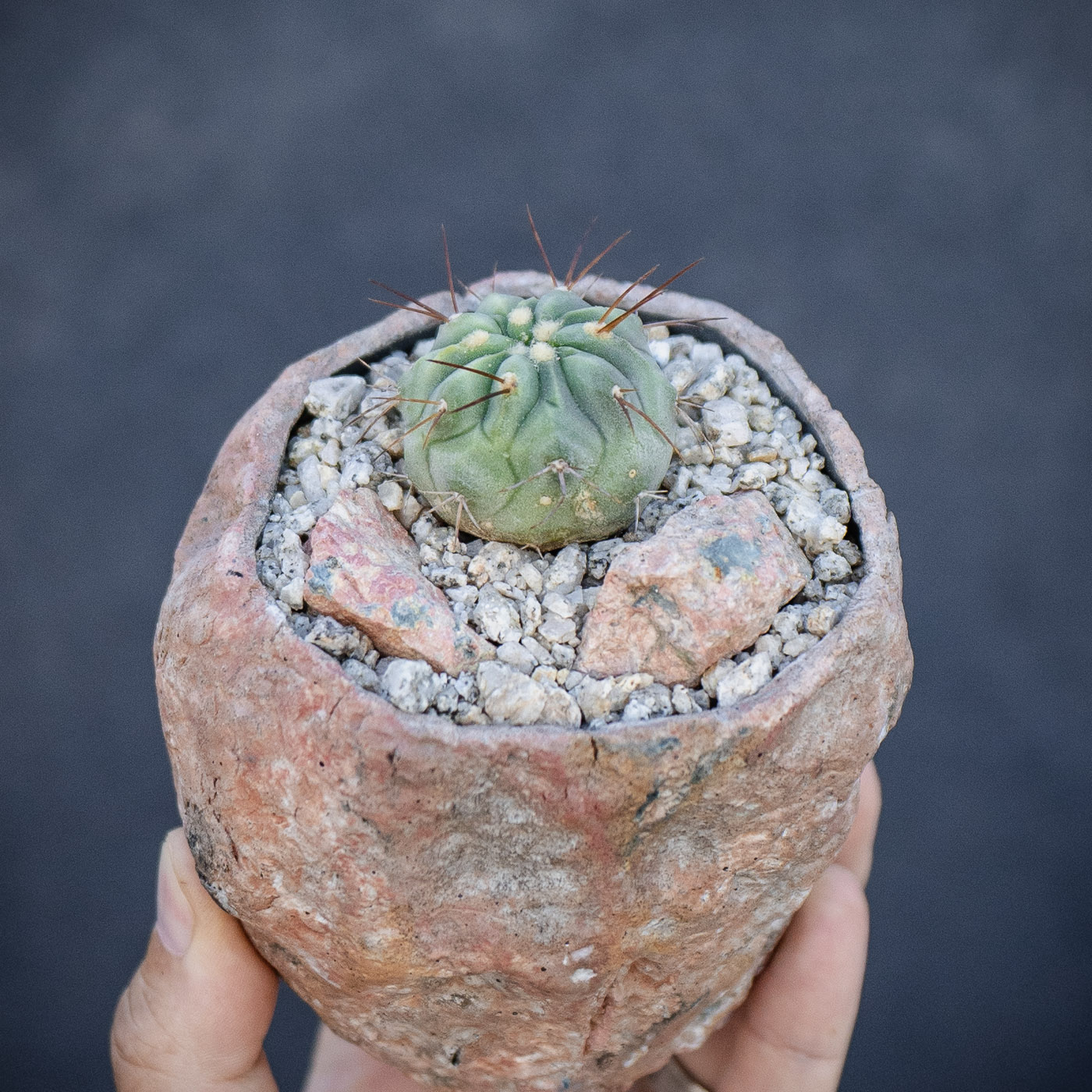
Copiapoa dealbata f. brown spine
Acquired17 days ago10/1/2026
PotterUngrounded Objects
Notes
Evolving along the coastal terraces of the Atacama Desert, this species relies heavily on the regular, cooling camanchaca sea fogs rather than rainfall. In a coastal Zone 10b environment, replicating this extreme aridity is vital to maintaining its signature chalky-white epicuticular wax and intense spine coloration; overly rich soil or excess moisture will cause the plant to bloat and lose its waxy bloom. It demands an uncompromisingly porous, inorganic mineral substrate, making your 80% premium pumice blend cut with coarse decomposed granite and calcined clay ideal to mimic the sterile coastal gravels of Carrizal Bajo. Housing this specimen in a hand-crafted, breathable raw cement pot provides vital root stability while wicking away residual moisture around the base. Water must be applied with extreme restraint only during warm summer stretches—allowing the substrate to dry out completely between soakings—and strictly withheld throughout a cold, bone-dry winter dormancy beneath a solid polycarbonate roof to protect against cold seasonal rains.
Origin
Chile. This localized, distinct spine-color variant originates from the hyper-arid coastal terraces and gravel plains of the Huasco Province in the southern Atacama Desert, particularly around Carrizal Bajo and Llanos de Challe National Park. In habitat, standard Copiapoa dealbata forms massive, multi-headed, domed mounds composed of hundreds of individual heads. While the typical form is renowned for its stark, jet-black armature set against a chalky grey-white waxy stem, the brown spine form is prized for its thick, needle-like spines that emerge in rich chestnut, amber, or deep reddish-brown tones before gradually weathering to an ashy grey. The stems remain globose to shortly cylindrical with prominent, acute ribs and a thick epicuticular wax layer, topped by a woolly crown that pushes satiny pale yellow flowers during the warm season.
Note: Coordinates indicate a general region for educational purposes and are not exact locations. Please do not use them for collection or poaching.