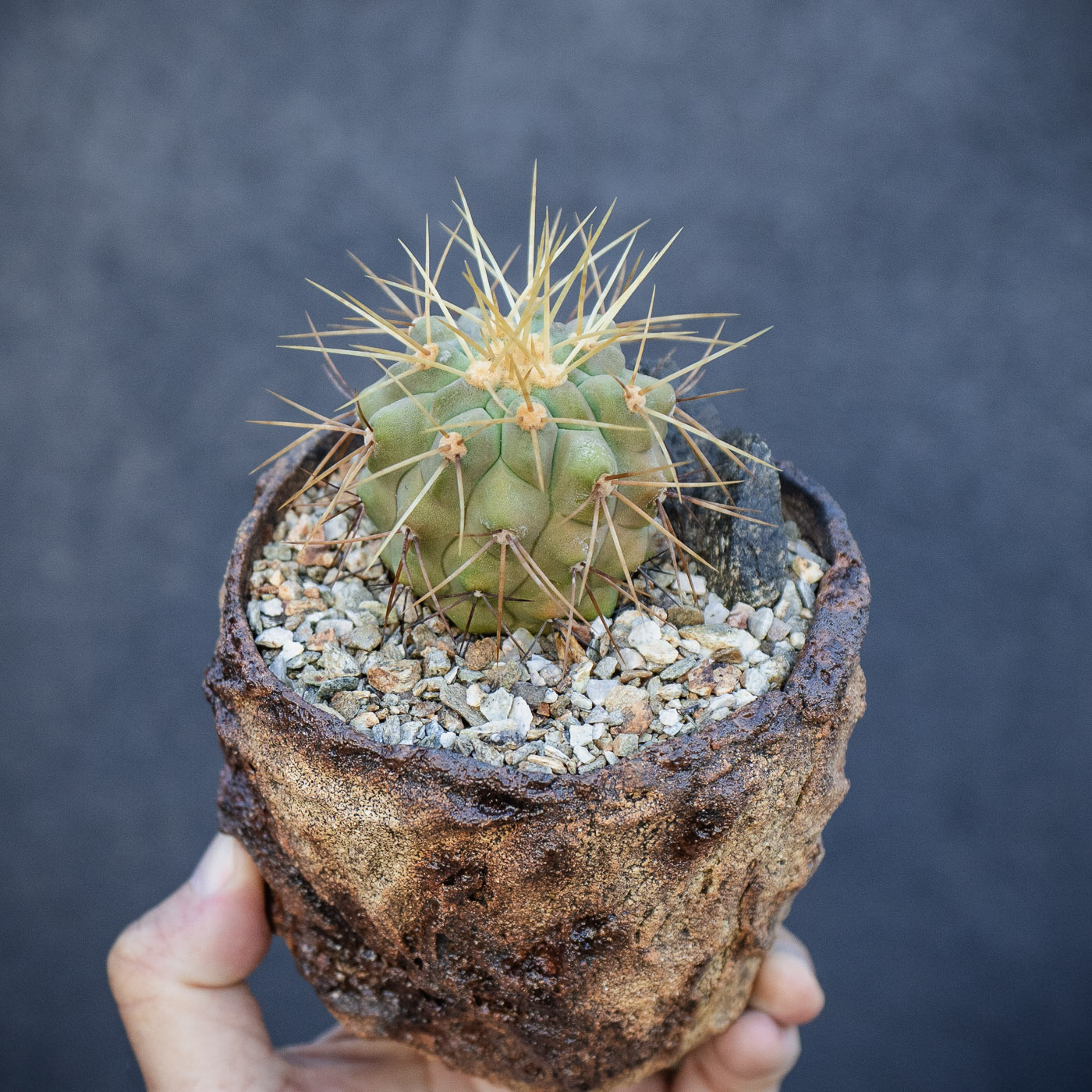
Copiapoa haseltoniana subs. eremophila
Acquired16 days ago10/2/2026
PotterKitoi
Notes
Evolving along the high coastal ridge, this subspecies survives off atmospheric moisture harvested from the upper boundaries of the camanchaca fog bank. In a coastal Zone 10b environment, maintaining strict mineral purity and intense solar radiation is critical to promote its signature golden-to-black spination and dense crown wool while preventing stem bloating. It demands a hyper-porous, fast-draining mineral substrate, making your preferred 80% premium pumice blend cut with coarse decomposed granite and calcined clay ideal to match its native granitic habitats. Cultivating this slow-growing mounding species in a hand-crafted, breathable raw cement pot provides necessary root stability while rapidly wicking excess moisture away from the crown. Water should be applied conservatively only during warm, breezy periods of active summer growth—allowing the substrate to dry out thoroughly between soakings—and strictly withheld during a bone-dry winter dormancy beneath a solid polycarbonate roof to shield against cold seasonal rains.
Origin
Chile. Endemic to a distinct high-altitude zone in the hyper-arid coastal range of the Antofagasta Region, localized in the steep, rocky inland hills and quebradas directly east of Paposo. Occurring at elevations ranging from 600 up to over 1,000 meters above sea level, this subspecies occupies a harsher, more inland transition zone than standard low-elevation coastal haseltoniana. It forms massive, heavy-stemmed mounds over time. The plant is distinguished by its light green to bronzed epidermis, prominent orange-amber woolly crown, and dense, needle-like spination that emerges in striking honey-yellow to golden-brown tones before aging to a deep charcoal or jet-black. During late summer, satiny yellow flowers push directly through the rich apical wool cushion.
Note: Coordinates indicate a general region for educational purposes and are not exact locations. Please do not use them for collection or poaching.