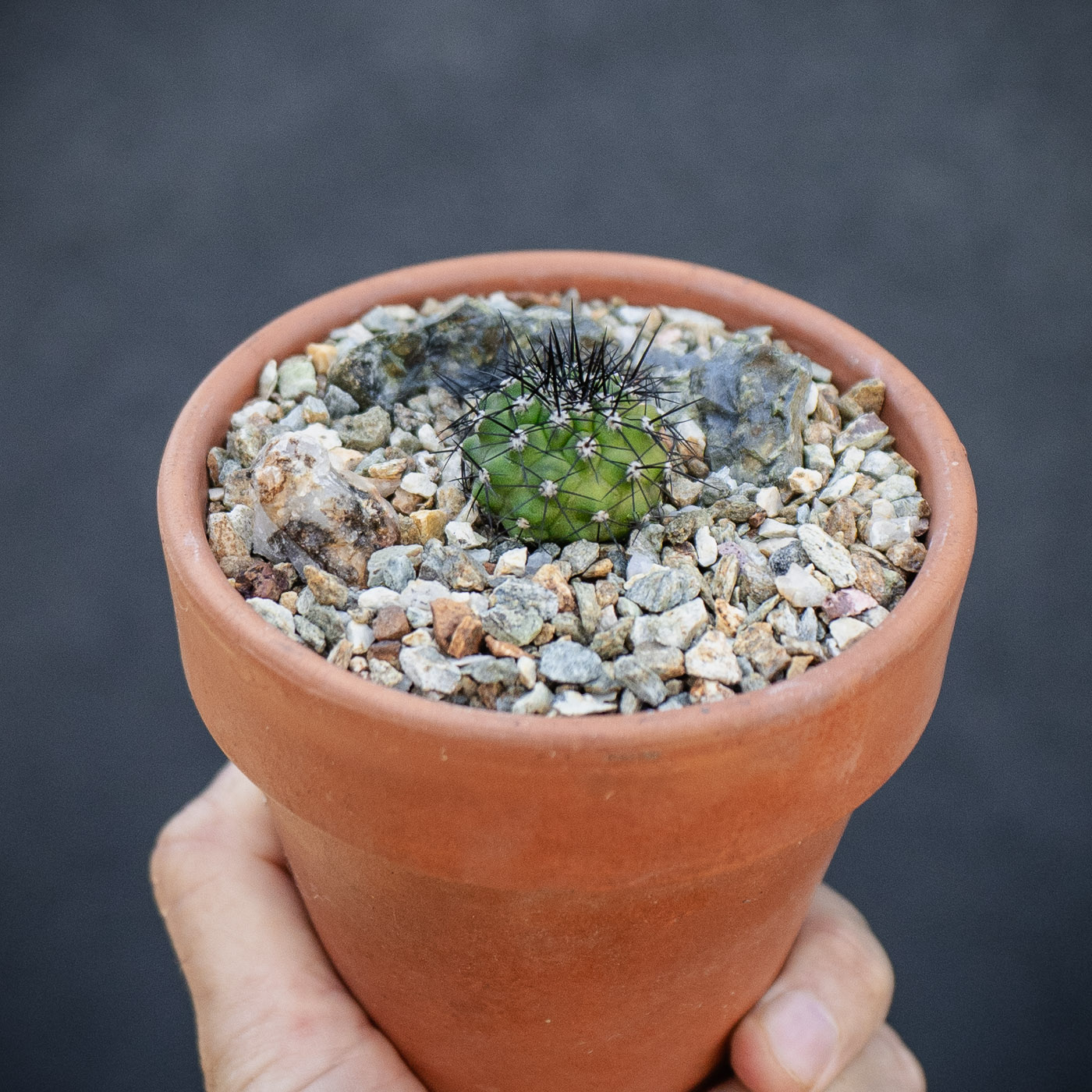
Copiapoa hoffmanniana
Sowingover 1 year ago2/14/2025
Acquired24 days ago9/24/2026
Field Data
JN 2603Field NumberJN 2603
Recorded ByJan Novák
LocalityEl Caleuche, Unknown
Field data provided by rarecactus.com
Notes
Evolving in a hyper-arid coastal desert where measurable rainfall is a rarity, this species survives by capturing moisture from the camanchaca—the dense, cooling sea fogs that roll inland. In a coastal Zone 10b environment, replicating this severe aridity is critical to prevent rot and maintain its compact, heavily armored form. It demands a highly aerated, virtually soil-free mineral substrate, making a gritty 80% premium pumice blend perfect for mimicking the sterile, rocky soils of its habitat. Cultivating this slow-growing specimen in a hand-crafted raw cement pot ensures rapid evaporation and vital root aeration. To protect the root system from unexpected cold, stagnant winter rains, housing it permanently under a solid polycarbonate greenhouse roof is essential.
Origin
Chile. This distinct and highly sought-after field collection by Jan Novák (JN 2603) hails from El Caleuche, situated at an elevation of 550 meters in the hyper-arid Atacama Desert. Thriving on rugged, sun-baked mountain slopes and mineral-dense coastal terraces, Copiapoa hoffmanniana is characterized by its heavily armed, robust globose to cylindrical stems. To survive the extreme solar radiation, the plant develops a chalky, pale grayish-green epidermis masked by a dense, interlaced matrix of thick, rigid, dark gray to nearly black spines. Over decades, these solitary stems slowly offset to form impressive, densely packed cushions. In late summer, it pushes satiny, pale yellow flowers directly from the dense, woolly apical crown.
Note: Coordinates indicate a general region for educational purposes and are not exact locations. Please do not use them for collection or poaching.