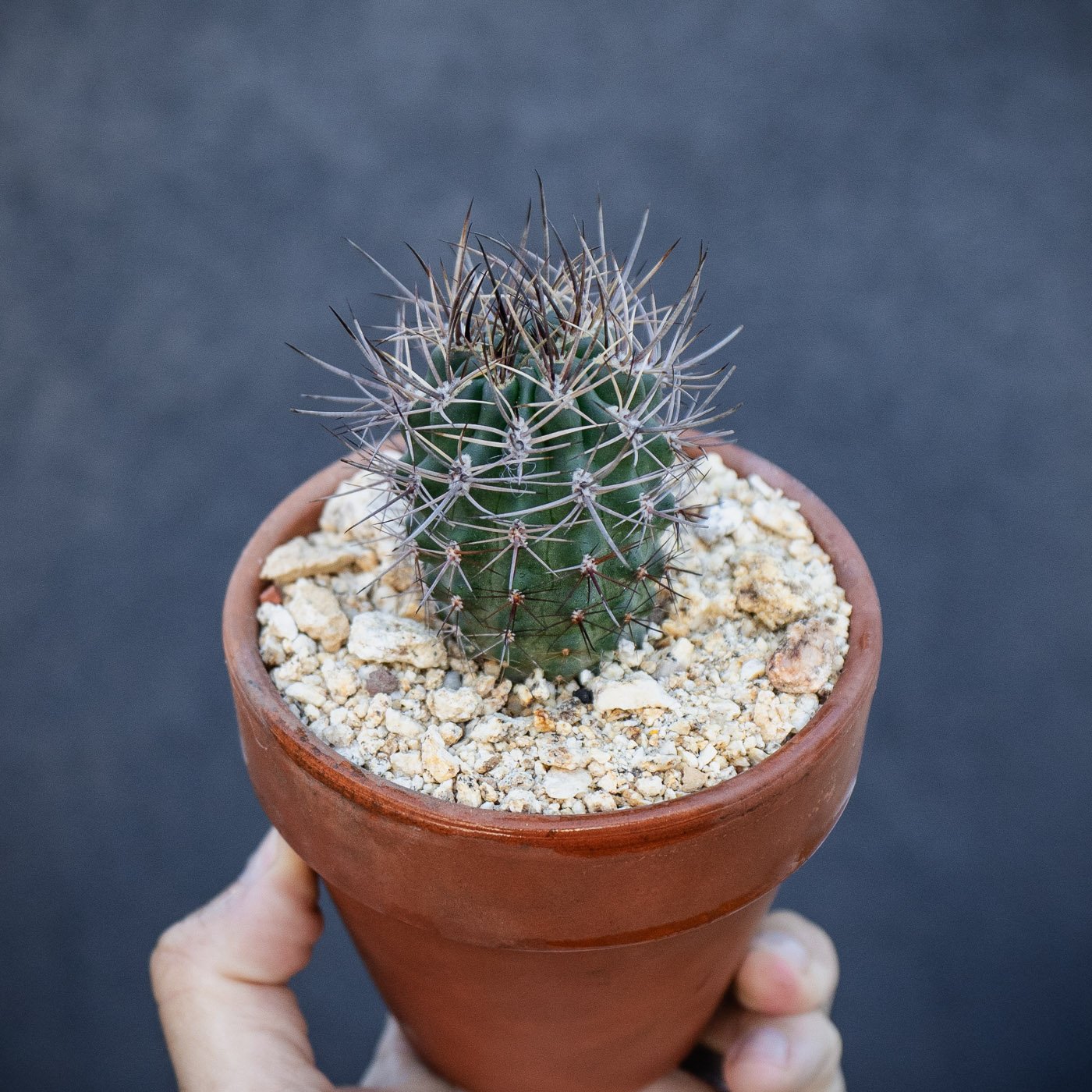
Eriosyce aurata
Acquired16 days ago10/2/2026
Notes
Hailing from interior mountain slopes and dry Mediterranean valleys that experience blazing summer sun and cool, relatively dry winters, this species is exceptionally tough yet sensitive to stagnant subterranean moisture. In a coastal Zone 10b environment, its primary need is maximum UV exposure to maintain its signature golden spination, combined with uninhibited airflow to prevent humidity build-up within its dense spine matrix. It requires an uncompromisingly porous, coarse mineral substrate—such as an 80% premium pumice blend cut with coarse decomposed granite and calcined clay—to match the sterile, granitic scree of its native Andean slopes. Housing it in a heavy, highly breathable raw cement pot provides vital counter-weight for its massive barrel form while wicking excess water rapidly away from the root system. Water should be applied deeply but conservatively during warm, breezy summer stretches, ensuring the substrate dries out completely between soakings, and strictly withheld throughout a cold, bone-dry winter rest beneath a solid polycarbonate roof to protect against cold seasonal rains.
Origin
Chile. Known locally as "Sandillón" (giant watermelon) due to its impressive, heavy barrel-like form, this majestic species is endemic to the arid, sun-scorched foothills and high-elevation inland valleys of central-northern Chile, primarily throughout the Coquimbo and Valparaíso regions. In habitat, it grows across rugged granitic scree, rocky ridges, and dry scrublands at elevations ranging from 500 to over 2,000 meters. It begins as a solitary, slow-growing globose stem before aging into a massive, thick cylinder up to a meter tall and half a meter wide, sometimes forming huge clumps over centuries. The body is densely armed with a thick, interlocking cage of curved, horn-like yellow to deep golden-brown spines projecting from acute ribs. In summer, mature specimens produce a ring of satiny, bell-shaped reddish-yellow to amber flowers half-buried in the dense, woolly apical crown.
Note: Coordinates indicate a general region for educational purposes and are not exact locations. Please do not use them for collection or poaching.