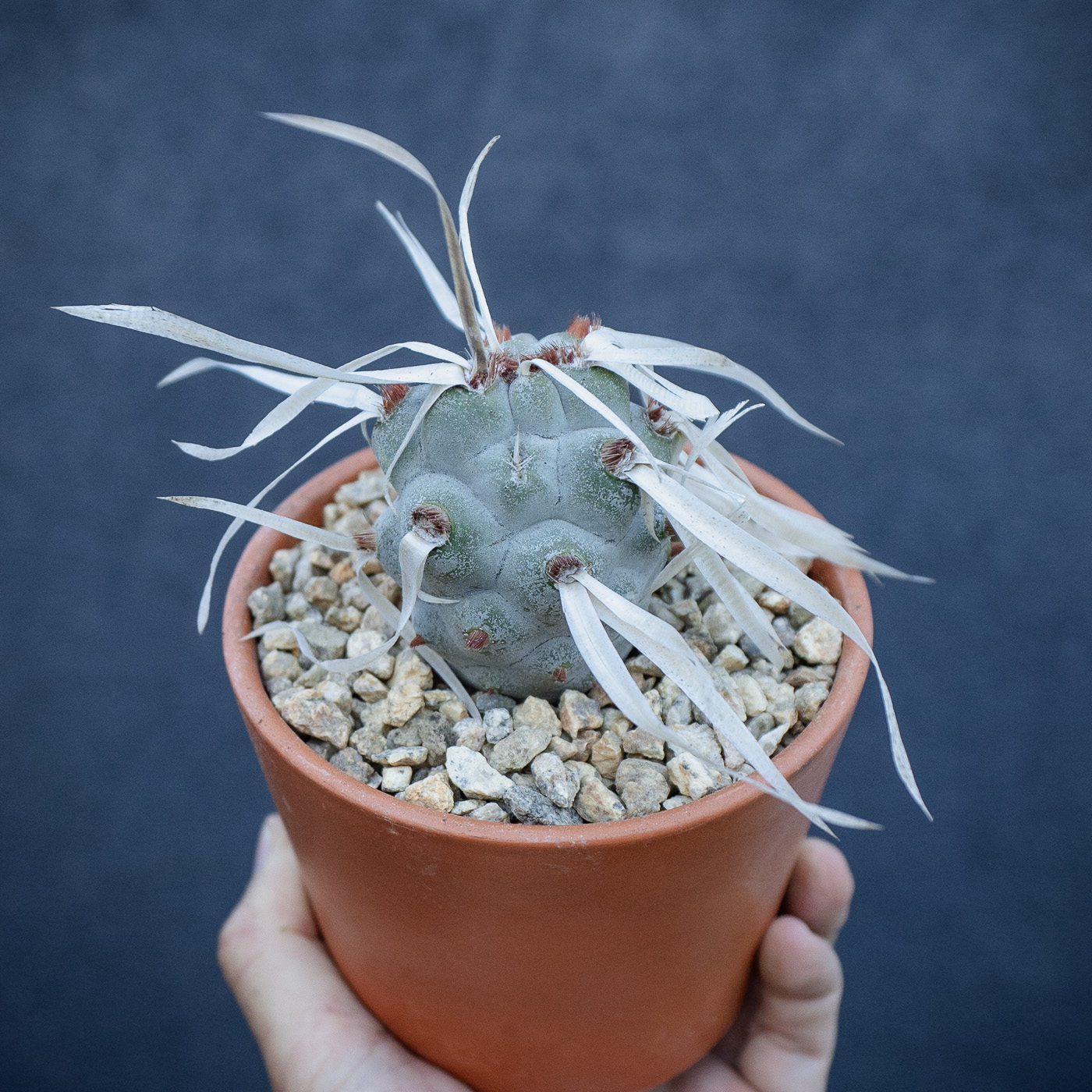
Tephrocactus articulatus
Acquired3 months ago8/16/2026
Notes
Hailing from an Andean rain-shadow environment defined by dry winters and warm, sporadic summer rains, this species relies on high thermal energy and bright sunlight to push new segment growth. In a coastal Zone 10b environment, maintaining full, unfiltered sun and excellent air circulation is vital to prevent segment joint weakness, green stretching, and soft growth. It demands a hyper-porous, lean mineral substrate—making your 80% volcanic pumice blend cut with coarse decomposed granite and calcined clay ideal to replicate its native Andean scree and gravel flats. Cultivating this specimen in a porous, breathable raw cement pot ensures rapid moisture evacuation, protecting its shallow, sensitive root system from standing moisture. Water thoroughly during warm summer growth periods, allowing the substrate to dry completely between applications, and enforce a cold, bone-dry winter rest beneath a solid polycarbonate roof to protect against wet rot and encourage structural segment firmness.
Origin
Argentina. Endemic to the harsh, high-altitude arid scrublands, desert basins, and gravelly slopes of western Argentina (spanning the provinces of Salta, Catamarca, La Rioja, San Juan, and Mendoza). In habitat, it grows fully exposed to intense high-elevation solar radiation, extreme diurnal temperature swings, and severe winds. It forms loose, segmented chains of rounded, globe-to-pinecone-shaped jointed stems (cladodes) that easily detach when disturbed to propagate vegetatively. The grey-green to ash-colored epidermis is studded with prominent, woolly areoles that bear distinctive, flat, papery, non-wicking spines that mimic dry grass or debris to deter herbivores and buffer intense UV exposure. During late spring and summer, delicate, satiny white to pale translucent flowers emerge from the upper segment tips.
Note: Coordinates indicate a general region for educational purposes and are not exact locations. Please do not use them for collection or poaching.